
Illinois Institute of Technology · Career Services
Chicago Is Your Campus: What the Skyscraper City Teaches Illinois Tech Students
Career Services · Elevate · Open to every program
Click the image to watch the full episode on WTTW (opens in a new tab).
On October 16, WTTW/Chicago PBS premiered Chicago Stories: Skyscrapers, a documentary about the visionaries, rivalries, and engineering feats behind Chicago’s skyline. Several members of the Illinois Tech School of Architecture community appear throughout the film, including Reed Kroloff, Dirk Lohan, FAIA, Carol Ross Barney, FAIA, and Lee Bey.
It is worth watching for the history alone. But for Illinois Tech students, it is also a reminder of something easy to forget between classes: the city is part of your campus. The buildings in the film are not textbook examples on the other side of the world. They are a short train ride from where you study.
1885
Chicago’s Home Insurance Building, often called the world’s first skyscraper
1938
Ludwig Mies van der Rohe arrives to lead architecture at Armour Institute, which became Illinois Tech in 1940
1956
S. R. Crown Hall opens on our campus; it became a National Historic Landmark in 2001
Minutes
by Green Line from the 35th-Bronzeville-IIT station to the Loop
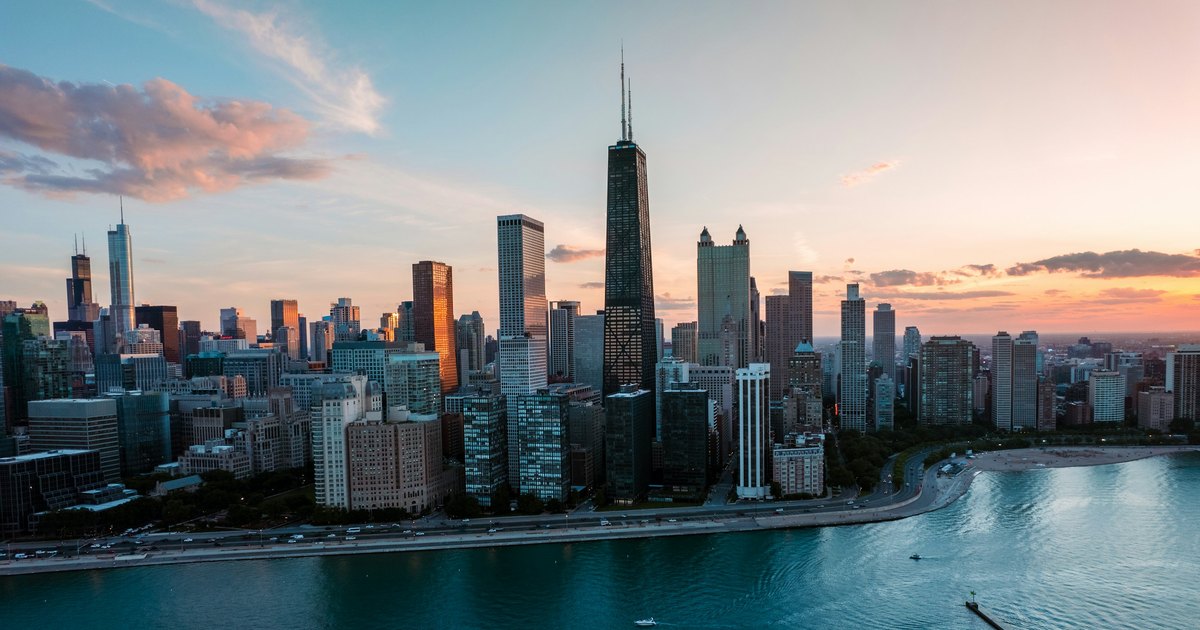
The former John Hancock Center, built on Fazlur Khan’s braced-tube design. Photo: Zander Betterton / Unsplash.
Other Universities Have a Lab Building. Illinois Tech Has a Skyline.
The big idea
Medical students learn in teaching hospitals. Marine biologists learn on the coast. Illinois Tech students learn in a teaching city: a place where nearly every major idea in tall-building design was tested, built, and argued about in public.
Compare that with how most students meet architecture and engineering: through slides and case studies of places they may never visit. Here, the case studies have street addresses. You can stand under a structure you read about that morning, see how it meets the ground, watch how people move through it, and ask why it was built that way.
Our own campus is part of the story. Mies van der Rohe designed about 20 of its buildings, and Crown Hall, home to architecture at Illinois Tech, is one of the most studied buildings of the 20th century. You do not visit the history of modern architecture here. You go to class in it.
What Chicago Invented, and What It Is Still Testing
Then and now
The documentary shows how Chicago solved the problems of its time. Each of those breakthroughs maps to a question the city is working on today.
Then
The steel frame
After the Great Fire of 1871, Chicago rebuilt upward. Steel frames let buildings rise higher than heavy masonry walls allowed; compare the Monadnock Building’s thick load-bearing walls with the lighter frames that followed.
Now
New materials. Engineers and architects are testing mass timber, low-carbon concrete, and recycled steel to cut the carbon built into new towers.
Then
The glass wall
Buildings like the Reliance Building and Mies’s 860–880 Lake Shore Drive apartments showed what glass and steel could do.
Now
Energy and comfort. All that glass now raises questions about heat, cooling, and energy use, and how to retrofit older towers to meet climate goals.
Then
Taller and stronger
Engineer Fazlur Khan of Skidmore, Owings & Merrill, who also taught at Illinois Tech, developed tube structures that shaped the John Hancock Center and Willis Tower. The Hancock’s braced tube used far less steel per square foot than the Empire State Building.
Now
Smarter buildings. Sensors, building data, and digital models let teams study how towers actually perform and how people use them.
Then
The office district
The Loop grew into one of the country’s great downtowns for business.
Now
A downtown in transition. Through LaSalle Street Reimagined, the city has advanced six projects to turn older Loop office buildings into about 1,765 apartments; the first, the Bellwether at 79 W. Monroe St., opened in September 2026. Adaptive reuse, public space, and transit all become live research questions.
Then
The river as infrastructure
The Chicago River was reshaped to serve a growing industrial city and even reversed in 1900 to carry sewage away from Lake Michigan.
Now
The river as public space. The Chicago Riverwalk, designed by Ross Barney Architects with Sasaki, shows how a city can reclaim infrastructure for people, and how much there is still to learn about resilience and flooding along the water.
Research Waiting to Happen, for Every Major
Downtown is a lab
You do not need to be an architecture student to use Chicago as a lab. Downtown is full of open questions, and each discipline sees a different one.
Engineering
How do older towers perform in extreme heat, wind, and cold, and what is the most efficient way to retrofit them?
Computing & Data
What can building sensors, transit data, and city open data tell us about how people actually use downtown?
Design
How do you turn an empty office floor into a home, a lab, or a classroom people want to be in?
Business
What makes an office-to-residential conversion pay off, and who decides?
Science & Sustainability
How much carbon is locked in the existing skyline, and how much can reuse save compared with building new?
Humanities & Social Sciences
Who gets to use downtown, and how do design decisions shape access for neighborhoods like Bronzeville?
From Reading to Research
The difference between reading about cities and studying them is often just a train ride and a good question.
Each of these questions can become a class project, an independent study, a research experience with faculty, or the start of an internship conversation.
Start on Campus, Then Go Downtown
Elevate’s On-Campus channel is the best place to plan your first trip. Its On Campus and Beyond guide pulls together architecture, tours, and public art; free museums and cultural sites; Black heritage and global Chicago; parks, trails, and day trips; and local event sources, alongside campus jobs and campus involvement.
Watch the episode, pick one building from the film, and use the guide to build a route around it. Explore On Campus and Beyond →
Turn the City Into Experience With Elevate
- 1Meet with a career coach. Book on Handshake to talk through your interests and map the experiences, research, and connections that fit your path.
- 2Explore Elevate Experiences. Find projects, research opportunities, internships, and industry connections, many of them rooted in Chicago.
- 3Go see it in person. Walk the buildings from the film, take the Green Line downtown, and bring your questions to class, to your coach, and to the professionals you meet. The On-Campus channel can help you plan the trip.
- 4Earn credit for what you learn. Elevate experiences count toward digital badges mapped to the skills employers look for, recorded on your co-curricular transcript.
Chicago built the skyscraper. What you build next starts here.
Watch the episode, then go see the buildings for yourself.
Book a career coach or plan your first trip with the On-Campus channel.
Connect With Us
Career Services and Experiential Learning · McCormick Tribune Campus Center, Suite 106
Walk-ins: Monday–Friday, 10 a.m.–4 p.m., based on availability
elevate@illinoistech.edu · 312.567.6800
More on Chicago as your campus: Elevate On-Campus →
Chicago Stories: Skyscrapers is produced by WTTW/Chicago PBS. Skyline photo: Zander Betterton / Unsplash.
By Freddrick Logan, Experiential Learning Manager
Facts and external resources independently verified by Career Services, November 2026.


